Saturday, January 10, 2009

Why Postal Companies Are Going Down the Drain

Warning: rant!

Today I sent off an MS of 60 pages to the USA. Since that weighed over 200 grams, I had to pay 10.45 euros for the privilege. The economy option for post outside the EU has been discarded: it's either the priority rate or nothing. This is insane: I will now endeavor to send MSs only through email (even more than I already did).

Then I wanted to send a small envelope of business mail to the UK. Not only has the economy option for that been dropped, as well, but you must buy a minimum of 5 stamps, as of January 1. I only need one stamp, not five. Also, years ago postage rates would remain the same for years on end. Now the rates are increased every year, so those other four stamps will be useless if I don't use them before the end of the year.

The lady at the post office had already put the 5-stamp package in front of me, expecting I would accept that kind of policy without question. This sort of monopolist shenanigans makes my blood boil, and in turn my stubbornness goes to 11 (on a scale of 10).

So fuck that: I've sent it off with two old stamps I still had who together were worth more than the priority rate. On top of that, I'll scan the signed contract at the day job next Monday, and email it. I will try my damnedest to do as much of my correspondence over email (if possible *all* correspondence).

Thus, large national postal companies (I understand that the Royal Mail and USPS are just as bad) will continue to lose small customers (yes: citizens like you and me) through their insiduous ways of charging outrageously, and will end up mostly servicing large customers that send of mail in bulk, and thus get good discounts.

However, there are already many private companies doing that, and since these offer cut-throat rates (for bulk shipments only: just try to send a single package through a private mail company, and watch the price) in combination with horrible service (and I've seen quite some rants aimed at UPS, DHL and FedEx in the blogosphere), that is the way the national mail companies will go.

And indeed, Dutch TNT Post (already partly privatised) has already announced job cuts for the upcoming five years, even if they continue to make a profit. You see, they have to *continue* to make a profit, as they're not a fully national comany anymore. So they increasingly focus on the commercial market, and keep increasing the prices for small customers.

SF magazines are one of those 'small' customers: sending out a few thousand (let alone a few hundred) is not enough to get a bulk discount. So the postal rates for them go up, considerably, as well. Therefore, SF fiction print magazines are doomed (or more doomed than they already were): mailing costs will go up, and sending the magazines through commercial companies is even more expensive. In the abscence of growing subscription numbers, the only thing left (apart from going fully online) is cutting costs. Therefore Asimov's and Analog have changed size, and F&SF has lowered its publishing frequency. However, if USPS keeps raising its prices -- and they will -- it's a losing battle (and it pains me to say so).

And the national postal companies will become indistinguishable from commercial shippers, with the only difference that they must deliver mail to even the smallest of customers. By boy, will they charge you for it!


Saturday, December 20, 2008

Some Cheese, Wine & Beer Blogging

For the few people still hanging on: apologies for the relative silence. Of late, most of my blogging energies went into the Shine anthology weblog. Expect some major announcements and fresh developments on that soon.

Also, it was very busy at the day job: I was having nothing but back-to-back training sessions from the Summer onwards, with barely a day or two to recover in between.

OK: let's start with some wine. From my employer I got two bottles of Grande Visière. I tried it last Thursday, and didn't like it. I tried it again on Friday, and it still didn't work. I tried it the last time today: I guess it's OK as table wines go, but it just doesn't have any character: a middle-of-the-road red that is just a little bit too sour and too plain unremarkable to make any kind of impression. A 3 on a scale of 10, or a 1.5/5 as Wineass has it.
Since I'm at it, a Wineass-like Twitter review: Grande Visière French table wine: sour, dull. Like transmission fluid without lubricating properties. Free, 1.5/5, use only in emergency.
I actually threw it down the drain after tasting the Lehman: with wine I just can't be bothered with second class products (nothing to do with price: some cheap wines can be very good).

Then in the local Gall & Gall liquor store (where a very good friend of mine works) I bought a Spanish wine called Celeste (a 2005 crianza from Ribera del Duero), which I haven't opened yet (so expect a report later on), and a Peter Lehman the futures shiraz from 2003, which I opened.

According to Sylvia (my good friend at the Gall & Gall store) 2003 was one of Australia's best wine years, and it shows: I think it's divine. This is shiraz as it is meant to be (at least, according to my preferences): a red so deep it's almost black, rich forest fruits and plummy overtones, heavenly herbs and superb spices, subtle, fine grained tannins and a lingering, deep & complex aftertaste, like angels bleeding on your tongue.
Twitter review: 2003 Lehman the futures shiraz: fair dinkum. Forest fruits, plums, heavenly herbs & Superb spices. Angels bleeding on your tongue: €15, 5/5.


The cheese: I did some cheese shopping at Fons van den Hout, a delicatessen shop specialised in cheese in Tilburg. It's the closest shop (it involves a 20 minute train ride) where I can get the single Dutch truffle cheese: more than worth the short trip. I bought two cheeses there, and two from my local AH (Albert Hein) supermarket.

Also, I have the habit to put those -- sometimes expensive -- cheeses on LU (this is the brand name) crackers of the 'salt & pepper' variety: I find they combine real well with certain cheeses. Obviously, YMMV.
  • A gorgonzola piccante from Ballarini (from my AH supermarket);
  • A blue stilton which is the Christmas special in Albert Hein: you're supposed to drink port with it, but I have tried port several times (I have colleagues in Portugal who bring port, and I've tried it both in Portugal and Andalucía, but it just doesn't work for me. A matter of taste);
  • A mountain cheese from the Elzas (from Fons van den Hout);
  • A Dutch truffle cheese (ditto);
The blue stilton is both extremely crumbly and very smelly, and so blue-veined that mushrooms almost start to form: it's an aggressive cheese that takes no prisoners. Still, there is a certain complexity behind the near-overwhelming fungal and almost sickeningly sour attack on your taste buds. Definitely one for advanced cheese aficionados, and not one for the faint of heart. Strangely, I find it combines surprisingly well with Leffe Brune (see below).

The Elzas mountain cheese, on the other hand, doesn't make much of an impression on a first look: a plain cheese, halfway between soft and crumbly, with no fungal veins or speckled additives. Only the brown crust marks it somewhat. I tasted a piece of it in the shop, and it didn't immediately make much of an impression: this might also be due to the fact that it was very busy in the shop (good for them: they deserve the clientele) and that I was still slightly hung over from the office party of the night before.
However, after returning home and a refreshing shower it slowly reveals its hidden subtleties: a salt'n'mustard tang that works great with the almost sandy texture, combining the suaveness of a younger cheese with the character of an older one. Definitely a keeper, and a perfect accompaniment to the Lehman futures shiraz.

The gorgonzola piccante is an old favourite: when I do a four-cheese plate, I try to make a 50/50 mix of new and known. I tried the mild gorgonzola, but found that it was a bit too cowardly for my tastes. The piccante combines a certain tang with a certain smoothness, a bit like a very charming kid doing something naughty but getting away with it.


The Dutch truffle cheese (picture above): this one is the most difficult to describe for me. It combines the taste and texture of a 'belegen' cheese (in Holland this is a classification system to determine the amount of time a cheese has ripened: 'jong' -- young -- is up to four weeks; 'jong belegen' is 8 to 10 weeks; 'belegen' is 16 to 18 weeks; 'extra belegen' is 6 to 8 months; 'oud' -- old -- is 10 to 12 months; and 'overjarig' -- overaged -- is 16 months and older) with the phenomenal taste of truffles. How does a truffle taste? Well, this is a minefield: not only are there several types of truffles (black and white, summer and winter, and many others), and I suspect that this Dutch cheese uses the black truffle (the least expensive variety). Also, truffles are very pungent, so can easily dominate the palette.
However, when used in just the right amount they give extra depth, complexity and a certain suave smoothness to a dish (this can be a meat dish, over a pasta or a salad, or indeed in specialty cheeses). Think of the king of all mushrooms with a very earthy undertone and tangy, twangy, maybe even funky overtone (OK: it is undescribable. Do try it, if you get the chance). Restraint is the true mastery in combining cheese with truffles: too much truffles and they totally dominate the palette (if you want that, you might as well eat them pure, even if that's an expensive experience), too little and their complex suavity doesn't shine through.

Also, the very helpful lady in the shop in Tilburg gave me something extra: a dip (or sauce) to use with the cheeses: this is an orange marmalade-like concoction that I find works nice with more plain cheeses, but kills the complexity of the more advanced cheeses. So I'm only using it when in dire need (read: if I can't afford the real good stuff).

Now, I'm one of these drink multitaskers who think it's no problem to drink both a great beer *and* a fine wine during dinner. In some connoiseur circles this amounts to blasphemy, but since it's perfectly fine to have a seven (or more) course meal with a great diversity of dishes I don't see why I can't have the same diversity with drinks (and yeah, I know there are endless varieties of wine: I just like to have both beer and wine).

In summertime, I prefer wheat beers like Hoegaarden, Brugs Wit, Dentergems or a good German Heffe-Weissen. In wintertime, though, I prefer more heavy beers (apart from the Hertog Jan lager I drink year-round) like Leffe Brune and Corsendonk.

Leffe Brune
is the beer of choice tonight: a great complex darkly malted beer with caramel overtones: packs a good punch without knocking you out straightaway (in the manner a lot of triples do).

I also bought a Leffe beer glass: I think this is close to the perfect beer glass, an near-spherical bowl on a thick pedestal, think a wine glass for beer.

Sunday, November 30, 2008

The Police in Belgium

Don't mess with them...


Wednesday, November 19, 2008

I Have Been Interviewed...

...about optimistic SF and the upcoming SHINE anthology by Jay Tomio of BookSpot Central for their BookSpot Beat feature.

Sunday, November 16, 2008

The Diamond Ring Society

On Saturday November 15 there was another meeting of the 'Diamond Ring Society'. It's a not-so-secret cabal of Dutch solar eclipse chasers, consisting of my friends Peter v/d Linde, Bram LaPort, Ellen Dautzenberg and Freek Slangen. We met up in a bar in Amsterdam, exchanged pictures (that is: most of them gave CD-roms with pictures to me, as I'm not a photographer), and we discussed future solar eclipses.

First, finally some pictures of the August 1, 2008 total solar eclipse near Novosibirsk:

The shadow of the moon racing towards us over the lake;

The sky at the beginning of totality;

Snapshots of the total solar eclipse sequence:


First Contact until Second Contact;


Second Contact to Third Contact (totality with one protuberance and the solar wind);


Third contact to Fourth Contact;

The sky at the end of totality;

The shadow of the moon racing away from us across the lake;

(All pictures are made by Freek Slangen, a member of our not-so-secret cabal.)

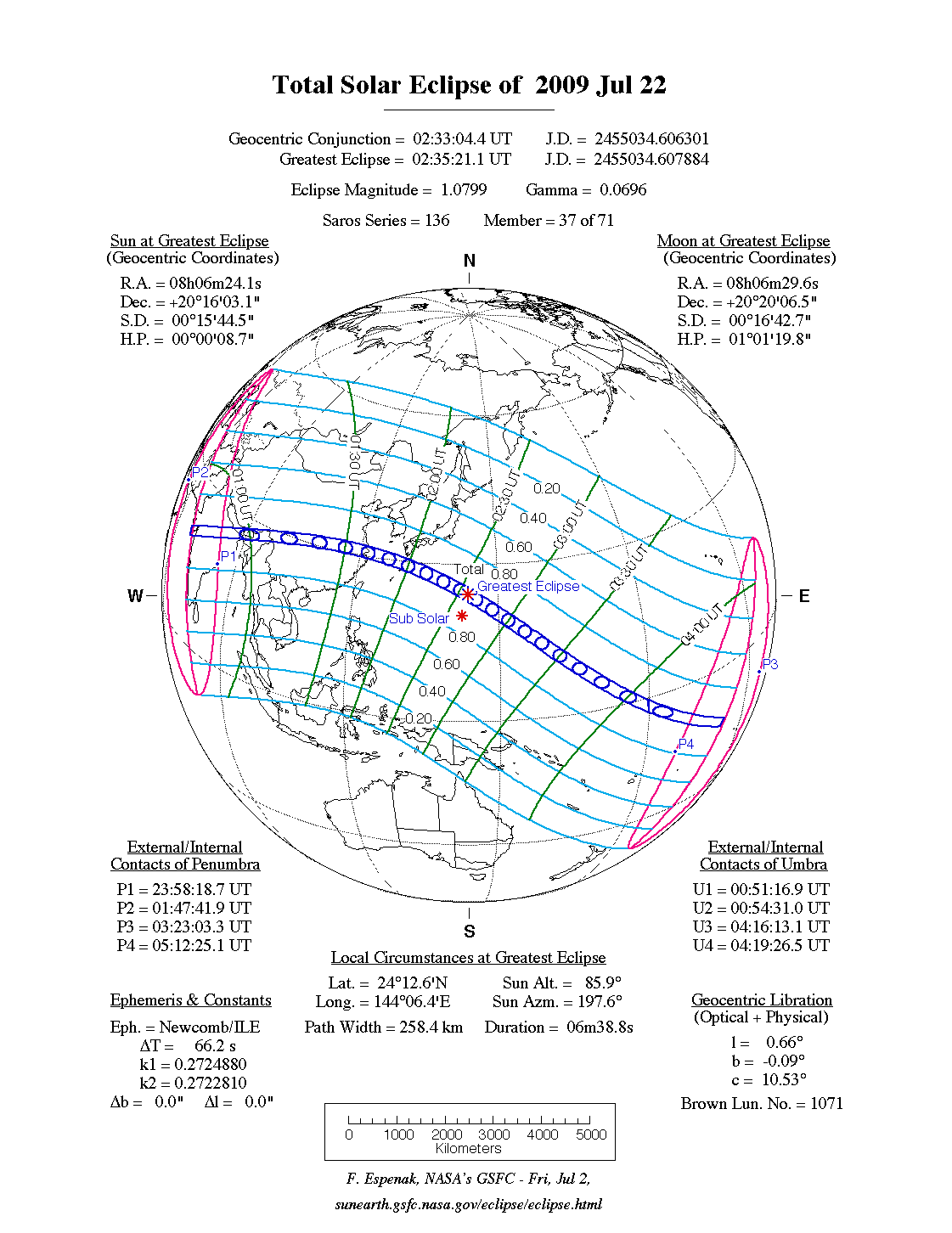
The next total solar eclipse is July 22, 2009, where the moon's shadow will cross over the north of India, over the Himalaya Mountains into China, then into the Pacific via Shanghai, passing just under Japan and off way into the Pacific (path here). My friends are looking at an organised travel arrangement via the University of Utrecht: for me this might be a bit too long (a three-week trip), as I intend to do WorldCon in Montreal (August 6 to 10), as well, and also World Fantasy in San José, and I only have so much days off.

So I might fly into Shanghai for a week, and join my friends in Wuhan (which looks to be one of the best spots: it'll be a tricky one, as July is the monsoon season in India, and the rainy season in China. This is compounded with the possibility of tyfoons, which generate an enormous amounts of clouds around their central twisters). Then get back home, stay home for over a week -- instead of a day like this year when I went from Novosibirsk, one day at home, then onwards to Denver -- and go to Montreal.

In 2010, there is a total solar eclipse on July 11, which is almost fully over the Pacific Ocean, and ends in Patagonia. It crosses over Easter Island, but all accomodation and trips for that are already fully booked now. So we're looking at French Polynesia or the Cook Islands.

Saturday, November 15, 2008

Relevant SF

(Cross-posted from the SHINE blog)

...or: The world is looking for solutions. Why isn't SF trying to help, or at least trying to think along?

In the past couple of weeks, I've been in airplanes quite a bit. My airplane reading is mostly newspapers and science magazines like New Scientist and Scientific American. So when I flew to Spain about a month ago I delved into the October, 11th New Scientist "A Brighter Future" special issue, and when I flew to Calgary two weeks later I bought Scientific American's "Earth 3.0" special issue. Then there's also Ode Magazine (I read the Dutch version, but there's also an English one) with a 'Generation Now' special report.

The similarities between the three: they're all worried about the (near) future. Indeed, just like SF, I hear you think. But unlike most SF today, these three magazines are not only analysing the problems, they're also actively looking for solutions. Why has most SF fixated on the former (often directly extrapolating today's problems in tomorrow's dystopias), while greatly ignoring the latter?

I strongly suspect that this is one of the main factors that keeps (written) SF from being relevant to a larger part of the population, especially young people. Not the sole one(*), mind you, but a very important one. I strongly think we need SF that starts thinking about near future solutions for our current problems.

Since our problems are complicated and interlinked, our solutions need to be multifacetted: most of today's biggest adversities do not exist in isolation, so multiple causes need to be addressed simultaneously. This requires multidisciplinary approach that is both broad and deep: one single specialist in one field (no matter how brilliant) will not do, but a group of 'intelligent optimists'. These teamworkers and teambuilders realise that there is no 'one-size-fits-all' solution, but that quintessentially different aspects require tailor-made solutions. They cherry-pick the best solutions from a great variety of sources, attack the problems from a lot of different angles, and are interdisciplinary, practical, forward-thinking go-getters.

Dog help me, I hear some of you think: this is immensely difficult. Indeed, it is. It's the point: SF can't afford to be too simple or straightforward anymore. Good near future SF not only reflects the complexity of the real world to a high degree, it also needs to see the intricate problems as tractable if we put our combined minds to it, with sharp intelligence, the will to co-operate, and hope.

So let's look at this in a broad perspective, and link the three 'special issues' I mentioned above:

  1. Our energy and water problems are interlinked: both crises must be solved together (this is the Scientific American "Earth 3.0" cover blurb almost ad verbatim). In the article, they link water usage to huge power plants such as combined gas/steam cycle, coal, oil and nuclear plants. And if alternative vehicles like hydrogen fuel-cells and plug-in electric vehicles get their charge from these huge power plants than they are water hoggers, as well:
  2. But the New Scientist "A Brighter Future" has this highly illuminating graph on pages 32 and 33 that depicts where alternative energies such as solar, wind, geothermal, biomass and tidal wave are most abundant across the world showing that the electricity potentially available from renewables (310,600 TWh) is much bigger than the total electricity being generated (19,014 TWh in 2006). Especially solar and wind energy use hardly any water: so if we power our electric or hydrogen fuel-cell or biomass hybrids with them we kill two birds with one stone: the energy and the water dependency. Only 433 TWh is generated by renewables, so the potential is enormous:
  3. Which bring us to Ode Magazine's "Generation Now": it sees higher oil prices as the trigger for decentralised generation of renewable power, both stimulated by governments (as has already happened in Germany and Spain) and by entrepreneurs, as Silicon Valley investors are now turning to investing heavily in green energy, and where people will try to make their houses self-supporting energy-wise ('energy-free living');

Again, why do I find this kind of positive, forward-thinking in non-SF magazines?

Two quick, off-the-cuff musings:

  • We need an urgent paradigmatic shift in economic thinking: the planet cannot sustain continuous economic and population growth. So combine a zero-growth (or a shrink-and-expand-to-the-same-size) economy while the population stops growing, as well (UPDATE: the 'zero-growth' economy was actually the theme of the 18th October issue of New Scientist, as Anthony G. Williams's post 'The Folly of Growth' reminded me. Thanks!). The European Union might be the forerunner in this: less economic growth over the last decade than the US or the new Asian tigers China and India, with a population that is stagnating or even shrinking while its people are growing older.
  • Suppose a platform like Liftport starts building a space elevator somewehere west of the Galapagos Islands, it could have the hydrocarbons it needs for its complex nanotube tether supplied by a company that is cleaning the Pacific from the accumulated plastic pollution. It uses solar and skysails powered vessels to get supplies to and from the space elevator's Earth base, it's presence in the tropics stimulates the nearby Latin American economies in a sustainable way, and more.

This is to get you -- and especially the SF writers among you -- thinking. Doesn't SF pride itself for it's potential for 'sense of wonder' and its ability to shift paradigms? The point is, these sensawunda-powered conceptual breakthroughs almost always happened in space, virtual realities and runaway technological singularities (and yes: I'm guilty, too). Bring the gosh-wow, preconception-shattering power of SF to address, if even partly, the current problems plaguing our planet (or help imagine new solutions, new approaches) and SF will become relevant again.

Another maxim has it that SF writers like a challenge. So what are you waiting for?

(*) = I fully agree with Paolo Bacigalupi -- see his interview in The Fix and an exchange I had with him on his blog -- and Ian McDonald that SF needs to become relevant again (we disagree, and probaly not even that much, on how to recapture that relevance: Paolo's focus is on environmental issues, while Ian has a thing with the Multiverse, while I think we should troubleshoot the lot -- the environment, the economy, the human tendency to short-term thinking, the lack of education, and the elephant in the room called overpopulation): spewing humanity all over the galaxy while we haven't decently solved our current, highly complex problems is a flight forward. We need to face our challenges now, and instead of fictionally wallowing in them, we need to start thinking our way out of them.

(NOTE: I love a good discussion, and haven't closed the comments on this post, but I would appreciate it if people would comment on the SHINE blog.)

Tuesday, November 11, 2008

SHINE weblog update

A weekly (or so, I hope) update of what's going on at the SHINE anthology weblog last week:

Foreign Sale

My story "Random Acts of Cosmic Whimsy" (originally published in Flurb #6) is now slated to appear in French magazine Galaxies (which has been relaunched at the last Utopiales, if I understand their announcement correctly) for the late February/early March issue, according to a reliable source.


Actually, there is another reprint (well, republish) of "Random Acts of Cosmic Whimsy" in the pipeline, but more of that if and when it happens...

Saturday, November 8, 2008

A Mosque Among the Stars


...is slated for a November 14 release. It contains my story "Cultural Clashes in Cádiz". It's one of the stories that portrays (at least one) Islam or Muslim character(s) in a friendly light.

Here's the page about it on the Islam and Science Fiction website.

Here's Ahmed A. Kahn's announcement of A Mosque Among the Stars (with a ToC).

Order it at ZC Books here.

And last -- but certainly not least -- there will be a launch event on November 22 at the Chapters bookstore in London, Ontario (from 2 to 5 pm). A Mosque Among the Stars will be jointly launched with Ahmed's collection Sparks. Call me biased, since I lifted Ahmed's story "Elevator Episodes in Seven Genres" from the IZ slushpile (it was published in Interzone #211), and he published me in A Mosque Among the Stars. But do check it out.

Wednesday, November 5, 2008

World Fantasy in Calgary...

...was brilliant. It was only my second World Fantasy and it has become my favourite convention.

I haven't made any pictures myself, so I will just point to the good people who have done so:

Laura Anne Gilman's pictures;

John Picacio's pictures (and blog post);

Ellen Datlow's pictures;

Lou Anders
's pictures (and blog post);

Kathryn Cramer's pictures;

John Klima
's pictures;

Marjorie Liu's pictures (and blog post);

Some of the many, many highlights included:

  • Unfortunately missed the Hades party at Wednesday evening because my flight arrived late, but the buzz in the Hyatt hotel bar was fine;
  • A relaxed lunch with David Levine & Kate Yule;
  • The Queensland Writers party;
  • The Johncon/Nightshade party in Jeremy's room, and going to a liquor store with Alan Beatts to get more booze when it ran out (and then needing to be subtly reminded by Alan that when Jeremy strips he might be indicating that the party is over, around 5.30 in the morning);
  • Doing the "Fantasy 'Zines Around the World Panel" with a monumental hangover but liking it nevertheless;
  • Great lunch with Gordon Van Gelder, Sean McMullen and Jenny Blackford afterwards the panel;
  • the Borderlands Scotch single malt tasting party (absolutely awesome! Both the whiskies and the party);
  • Having dinner with Diana Rowland on Halloween: she was dressed up as Sarah Palin and it took me a while -- we don't celebrate Halloween in Holland -- to realise just why she did that;
  • The first few days I had problems getting my bar bills paid: that is, the moment I went away for a few minutes (to go to the toilet, to talk with yet another fabulous person) and came back to get my check I found that somebody else had already closed the tab for me. I sometimes protested to be told not to worry about it. Then the last few days I made certain that I picked up a number of tabs from people -- often against their protests -- because good karma needs to go around and around;
  • Dinner with Marc Gascoigne (now Angry-Robot publisher), Sean and Catherine McMullen and Mike Gallagher: probably the best conversation I had in Calgary;
It was fantastic to meet so many people I didn't know personally (but was, in many cases, well aware of) like Shawna McCarthy, Daniel Abraham (David! Next time I'll buy Mexican lunch or dinner), Jenny Blackford, Robert Hoge, Justin Ackroyd, Shaun Tan, Nora Jemison, Steven Mills, Lawrence Connolly, Laura Anne Gilman, Jemma EveryHope, Nikki Kimberling, Rob Shearman (who might have been a wee bit shy initially, but looked like a veteran as the con progressed), Colleen Anderson, and several people whose face (and function) I remember, but whose name I forgot: I ask forgiveness.

And the many very good to good friends (and I'm not even trying to pretend this list is complete): Lou Anders, John Picacio, Paul Cornell (thanks for introducing me to Rob), Karen Newton, Bill Willingham (you should be working...;-), Chris Roberson & Allison Baker, Mary Robinette Kowal, Aliette de Bodard, Alaya Dawn Johnson, Doselle Young, Gordon Van Gelder, JJA (this anthology is METAL!), Marjorie Liu (next dessert will be on me), Jeremy Lassen (even if the 'Shade faded for a little while on Saturday evening...;-), Jim Minz & Jay Caselberg (don't mention the 'better' name tags), Ellen Datlow, Eileen Gunn, Jonathan Strahan, Garth Nix, Alan Beatts & Jude Feldman, Amelia Beamer & Liza Groen Trombi, Todd Lockwood, Kay Kenyon, Diana Rowland (creepy Halloween costume alright, and I'm glad I didn't look like her running mate...;-), Marc Gascoigne, Sean McMullen & Catherine McMullen (what not to do in Venice), David Anthony Durham, Steven Erikson, Rani Graf (I am finally remembering your name: so alcohol does not destroy braincells...;-), Christian Dunn & Mark Newton (obviously...;-), Graham Joyce, Daryl Gregory, John Klima & Mark Teppo, Adrienne Loska (good luck with the documentary!), Tony Richards, Farah Mendlesohn, Mark Rich, Leslie Howle, Walter Jon Williams, David Levine & Kate Yule, Ken Scholes & Jay Lake, Heather Lindsley (say hi to Al Golden --ehrm -- Robertson).

My profound apologies beforehand for all the great people I've met but forget to mention here, and all the great moments that I'm either skipping or temporarily (I hope) not remembering.

World Fantasy is the best!